Thursday, December 27, 2012

The Hidden Mouth

If you'd like to see larger versions of the photos included in this essay, just click on them.

The last time I went looking for dragons, and wrote of it here, it was early spring. There was a sense of decayed things emerging, then being overgrown, sublimated into green watercress. This time it's winter, things are buried.
The snow has come. It came late this year, the time between leaf-fall and snow-fall lingered until it seemed familiar, the way things might stay. When the snow did come, it came howling in sideways, preceded by ice and water. It ripped through powerlines breaking them and our little house was without electricity for twenty five hours. Not before I went out into the storm though. Into the forest which shivered and stilled, leaned away from the gale and caught snow in lines up the north east side of its trunks.


When the storm was over it had left winter behind it, gentler snow falls came in its wake.


Now I walk up the path through the forest to the dark place between the hills.


This is the day before the longest night and even in the early afternoon as I walk into the forest, the light dims. Snow has made the familiar path strange. Ahead, a set of tracks emerge and run straight up the white trail. They are big, the length of my palm. The wolf's cousin has been this way.


Eastern coyotes are as big as wolves but different. They combine the jackal nature of the smaller western coyote with the size of the grey wolves they interbred with and replaced as they colonized this region.


I walk on, following half-wolf tracks in the snow. It's like a pencil drawing, shaded with sketchy lines, all white and grey and black. Then a sudden shock of colour-- a pool filled with water-weeds like green fire.


I walk along the steep hillside looking down into powdered tree sketched dells.  I come to the hidden mouth. Trees have fallen down the bank and now grow sideways obscuring the entrance, but I can see a hint of darkness behind them. A breath of earthy air touches my nostrils and cheeks as I approach, careful not to let my feet break through the snow covered branches. I don't want to fall in the brook.


Under the branches, through a screen of trees, the ravine opens up, hung with ice and running back into the place between hills. It gurgles water over brown pebbles and under snow covered fallen trees.

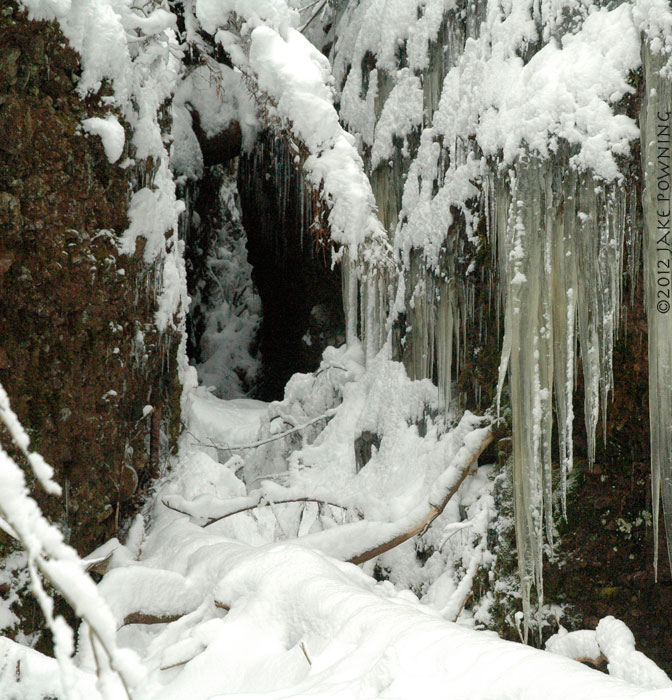


I climb into the dark space, look up with feet planted on either side of the narrow crack, water below me. High above, trees zigzag towards the sky.


A pile of fallen roots in the dimness looks like it might hide some shadowy tentacled thing, drawing unwary prey towards it with water gurgles and icicle light.


By now it's getting dark and when I return to my workshop I have to turn the lights on to work.


On my table are my design tools, pencils, vellum, compass and calipers, and a sword blade. I'm trying out using the system of geometry that my friend Peter Johnsson discovered to help define the proportions of a sword hilt, but I'll tell you about that in more detail in a later post. For now I can be thankful that I made it back safe and dry from my excursion. My pencil scratches vellum in the warm lamp light and the wind howls through a crack and spatters snow against the dark window.


Thursday, November 15, 2012

Mushrooms and an Axe


It’s as if the mushrooms' folded world has its own colour spectrum, warm and dark; brown, orange, red and yellow, a shiver of green in the darkness of a decaying log. Trees curve over the steep valley, grey barked, zigzagging the distant sky. This is a house of trees, earth walls rise steep on either side of the stoney floor, thick with moss. Branches are everywhere, the branches have mushrooms growing on them.


No comments:

Saturday, August 11, 2012

Dark Hollow


The forest king’s son hides in plain sight, the colour of dry spruce bark and fallen needles. How long must the spruce tree and frog have lived side by side to match each other’s skins? 

Down by the dry August riverbed, in the dark hollow, tree stumps watch with implacable empty eyes. Boreal chickadees swoop around me to land on dead branches like the notes of an insistent living song.


High on the hillside big old maples and moss-trunked beech listen to the young trees shush and dapple light. This part of the forest is quiet and brooding in high summer, shaded by leaves. The ground is wound with roots, like the woven fingers of old people, waiting. 


Here in the deep woods and at its edge with the sparse grassed field, the summer ebbs. 


The plants put forth their seed-down, ready to let go, to release next years hope into the wind.


Sunday, February 26, 2012

Between Deep Water and Dark Forest


"Turning tides, their regularities!
What is the heart, that it ever was afraid,
Knowing as it must know spring's release,
Shining heart, heart constant as the tide?"
                                     - Seamus Heany
[from the dutch of J.C. Bloem (1887-1966)]


High wind cut cold North Atlantic water in tattered edged waves, curving and crashing, and then sucking smooth pebbles in foam froth.

On the abrupt coast, spruce trees leaned over cliffs in sharp edged late winter sun.

The liminal space between deep water and dark forest was protected by a coastal ridge from the wind; but the sea was tossed, turbulent, humped in white edged rollers, coming in from the bay, carrying the smells of salt and sandstone.

Gulls curved along the rocky shore, past the stacked ghosts of pebble beaches a hundred million years old, exposed by the gnawing ocean.

Walking along the water I found the sun fallen in shards and captured it to bring it here to this strange place and show it to you.


Friday, February 3, 2012

Galdrgrimm


The sun cuts low through winter trees, woodsmoke hangs in the air.  Walking through the forest one day I find what's left of a raven dance, the steps clear in the snow. I can see where a raven has scratched it's beak back and forth drawing concentric lines.


As part of a project I have been drawing too, exploring Viking Age ornamentation with pencil and paint, I interpret the knotwork that was inlayed long ago on the blade of an axe that was found in a place called Mammen in Denmark.


If you look closely you can see that this is a beast tangled in it's own horns and body, head thrown back.  Viking Age ornamentation is expressive with a narrative purpose that forcefully shines from the arcane lines. Strange and beautiful, what must a Viking artist's dreams have looked like. These were the shapes of their fierce spirit allies; the heath monsters that they drew on their weapons to frighten their enemies.  Perhaps they believed that by tying them up in this way they where harnessing their power.

I have been exploring Mammen ornamentation for a sword I have recently completed. I've shown many of the steps of it's creation on this blog. Here is the finished product - Galdrgrimm.

This blade exemplifies the ancient European tradition of pattern welding. A mastery of this time consuming and challenging process produces a swirling star like pattern running down the center of the blade and a keen edge which has been folded and refined to produce a shimmering subtle effect in the steel. Galdrgrimm is forged of contrasting layers of carbon steel and has a subtle blue sheen from the tempering process. Two narrow fullers run down one side of the blade and a wide single fuller graces the other. 
The hilt and scabbard are carved in the Mammen style; a popular form of narrative ornamentation in Denmark and elsewhere during the Viking Age. It features looping intertwined figures of dragon-beasts and human forms. 


The figured maple wood of the scabbard seems to shift and ripple when turned in the light, adding a mysterious glamour to the complex knotwork. The high layer edge steel refracts light in a similar way to the maple, so that there are dimensions to this sword which can only be experienced in person.

"Galdrgrimm" is a combination of the old Norse word 'galdr' which was a sung incantation and the word 'grimm' which comes from an Indo-European root word that is cognate with the word thunder. Therefore "Galdrgrimm" roughly translates to "thunder-song".


hilt - bronze, blackwood 

blade -pattern welded 1075/8670m

scabbard - quilted maple wood lined with 
sheered sheep fleece, hand cast silicon bronze.

blade length - 26 3/4" 

hilt length - 6 1/4"

overall length - 33" 

weight - 2 lb : 7.0 oz


 Smoke curls from the chimney, winter ages, the setting sun glints on the ice bordered river.


Monday, December 5, 2011

Scabbard, Snow, Lichen Stone

I rise before the sun, the scratchy radio voices catalog what bad things have happened in the world while I slept.  But the world tells a different story-- out the old farmhouse window the dawn blooms impossible colours against the somnabulant landscape.

Two ravens sit warily in the orchard on the lower slopes of the hill, the world is pink as the ravens talk to each other and fly off.


Under the front porch two feral buck cats vie for territory, sleek and well fed, there are few mice to be found around the old farm.

In the shop I am working on a pattern welded viking sword with carvings in the Mammen Style. This is a type of ornamentation from 10th century Denmark which combines gripping beasts with spiral hips and wings which loop and intertwine with decorative dots.

 This is the second sword I will finish from the batch of pattern welding which I have cataloged on this blog since last winter.
 Here you can see the pattern in the steel created by the process of pattern welding. The edge is seven hundred layers of folded steel and the center is constructed from two bars of nine layer steel which have been twisted to mirror each other.

Before constructing the hilt and scabbard I start by drawing a full scale concept design of the sword and work out the details of how it will be suspended from the belt and what design motifs I will explore.

 the grip is carved from black wood in a series of vertebrate like rings with spaces for ferrules where it meets the upper and lower guards
 The scabbard is shaped and fit to the blade with a sheep skin lining, and now I draw the pattern I have designed onto it.  This pattern is inspired by a stone which I photographed at the Victoria and Albert museum in London.
 I begin to carve by cutting the pattern in with a scew chisel, shaped like a sharp triangle with an acute point; I cut the lines in for a touch-mark on the back of the scabbard.


 I carve the background out and begin to round the lines of the spirals and cords. slowly the pattern emerges over eight days of carving.


Finally I rub it with warm linseed oil and the figure in the beautiful rock maple jumps into relief adding an extra dimension to the carving which shimmers and changes when moved in the light.

...
I walk up the old hill behind the farm. The landscape is skewbald with snow, a white and brown patchwork, dusk already in the afternoon. Winters smell hangs on the air, crisp, bittersweet.


Dead branches form mouth-like winter dens in the undergrowth.

Tangled spruce, saplings and brambles, black red grey, bone white.
Lichen moss and snow are the stones winter clothes.


The beech trees hold their leaves all winter, they rattle in the wind.  Yellow grass against the dark forest. The hillside is full of grim beauty. Now it is time to light a fire in the kitchen, cast bronze in the foundry and write winter stories in the dim light.