Friday, October 28, 2011

Questing under the moon


The Year wanes; leaves wither and go dancing off into the land of moldering and glimmering bone colours.  Work is coming together after the many distractions and events of short summer.

Since I was a young boy, I have drawn dragons.


 There is something alluring about an inhuman intelligence, capable of human emotion and foibles, manifest in a powerful form, representing ancient human fears of the forgotten predator.
Over the last several years my perpetual study of Celtic and Germanic mythology has strayed into the strange land of mythological fear.  We are afraid of death, the unknown and also some things that we can't articulate. It seems like we have ancient memories of being prey and we weave this into our stories and our myths. In order to create a great hero one must create a truly frightening enemy;  and this is where our wonderous and malevolent western dragon comes in. The gate keeper of the western mysteries, greedy horder of gold, whose heart contains the secrets of the natural world and arcane knowledge.  In the story of Sigurd and Fafnir, when Sigurd the dragon slayer cooks the heart of the slain Fafnir and accidentally tastes the juices of the heart on his finger, he can suddenly understand the language of birds.  This is similar to several other stories about hero initiations from Celtic mythology - Finn who gains all the wisdom in the world from tasting the cooked juices of a magic salmon and Taliesin who finds prophetic poetic wisdom when he accidentally tastes three drops from the magic cauldron of Ceridwen.  
The story of the dragon slayer is about overcoming fear in order to gain wisdom.  It is also a compelling story of a lesser power overcoming a seemingly indomitable power through strength and intent.

The dragon slayer must have a magic sword forged in a secret manner in the forest, which can bring the mysteries of earth and fire to help him in his quest, and he must have a brave steed as a companion. Then he must undertake the perilous journey, which inevitably leads him through the backwards lands, into the chancy country of myth and symbol where our fears become manifest.


 The tribal northern Europeans loved dragons. These are my interpretations of two images from ceremonial jewellery from the early Viking Age. The twisting almost human creatures may be one of the ways the early Scandinavians represented dragons and trolls, those frightening changeling creatures that haunt the edge of dreams and the places between the settled reality of cot and farm and the uncertain wilderness of robber, wolf and ghoul.
 Our hero must confer with the spirits of his ancestors and petition the land spirits for help before he sets out on his quest.   He goes to the ancient stones on the wild hilltop under the cold starlight and sits in silent contemplation over his sword, to ready his mind and prepare to travel into the other lands where the dragon hoards its power. 


Then he sets out, leaving his helpers behind: all but one, his magic sword; until he is on foot in a wild rocky country of stunted trees and twisted stone.


Even the bravest may not succeed in their quest, or may find they are not equal to the task. Having travelled through the barren lands and found the lair, it may be that they have only brought the Wyrm a morsel of fresh hope -- to devour, shaken and broken like a cat-caught song bird, their quest and intent heaped on the hoard with the dragon's other playthings.
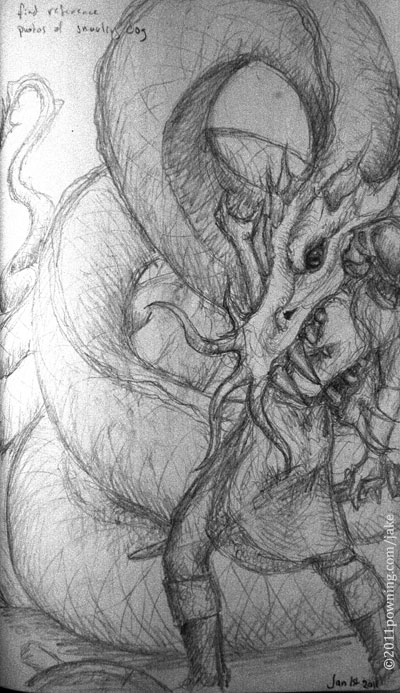
The stout-hearted hero, who travels through the land of dream without faltering or becoming distracted by phantasm or falling prey to the many pitfalls in the land beyond the bramble hedge, may brave through and capture the dragon's heart.  But remember, some dragons were once men, whose greed changed them until they became horrible and violent, and hoarded their knowledge like gold on the heath mound.


Monday, May 30, 2011

wandering at the edge of fear and beauty

 This morning, I walked into the woods.

 past the remains of human industry, moldering in the fresh shoots, turning brown and grey,
 across the stepping stone ford into the realm of the forest, where the primal imagination is at home and feels its roots.
 Tree roots twist in suggestive shapes; as a boy I believed a dragon lived up here; not a friendly wise dragon, but a black venomous dragon, wet and malevolent, deep in its crevasse, sleeping, but likely to wake.
 Walking through the edge forest, great spruce trees with many arms stand like strange beings with their own reasons for stillness.
 An old maple has been felled by the harsh winter, one half of it's trunk lies over the brook in a small forest meadow.
 I find myself walking up the path towards the ravine, I am in search of dragons and fantastical beasts today and where better to look than the place that a small boy knew to be enchanted, dangerous and wonderful.  Ferns lay on moss, the fresh green is like a tonic after so much darkness and cold. 
 As I come into the deeper woods they become darker, pools reflect black branches, and I can imagine the world the ancient Europeans believed lay beneath them, dark and chancy, uncertain, frightening, beautiful. A world where writing is backwards.
 Higher in the hills blight beech grow, smooth bark broken by the blight sores.
 The brook that I am following runs by in a white spring rush, on startling green moss.
 Coniferous branches twist and snarl in curling tangled patterns.
 Natural meadows open every once in a while, stone, grass, water, light.
 I am close now to the ravine, an ancient yellow birch tree has died but given birth to several of its children out of it's trunk so they are twisted and rooty, over a pool filled with tree debris
 This tree has always fascinated me, many of the trees up here give the impression of frozen or stilled motion.
 Obscured by undergrowth a space of darkness, breathing cold breath and rushing water.  The smells of earth and wet moss fill the air.
 As I brush branches aside I come to the mouth of the ravine, this is as far as I dared come as a ten year old boy for fear of the dragon, but I came this far often.  Now I climb over fallen trees and follow the rocky bottom up through the stony gash into the hill.
 Water is loud over the stone floor and conglomerate sides of the two hundred foot deep ravine.
deep in the hill a water shoot slashes white into a pool.
 Looking back down the crevasse, mist obscures branches at its top.
 Fallen tree opens it's mouth but says nothing.
 Back down the path by the river, moss and tree roots, my imagination filling, never full, the more I feed it the bigger it grows.
 Erect green shoots breathe in morning mist. I look up to find that I am being observed, old hill father says not a word, but I smile at him.
 Back in the forge, I have been working polishing and hardening sword blades.
 I make sure they are strait, before heating them up and quenching them in hot oil, to make the steel hard.
 After they are quenched, the pattern in the steel emerges starkly, twists and swirls like rivers and tree branches, the vikings called them blood edies, these are the patterns that make the swords more than simple weapons and turn them into chancy mythological objects, perhaps there is meaning in the patterns, maybe the rivers gurgle hides a chuckle.


 Plunging an orange hued sword blade into the burbling vegetable oil.
 Once the swords have been hardened and I have tempered them,  I grind in the final edge geometry and begin to sharpen the edges.
 Then it is time for the laborious process of polishing, rubbing the blade with stones and abrasives, until it is smooth and ready to be etched to bring out the pattern that I have created in the steel.


 This blade has been polished enough to give it a rough etch to see the pattern, now I am ready to design the hilt and scabbard. After having visited a dragon lair I am ready to do this, this sword will be a mythical dragon slayer... blade writhen to the task, hilt marked with magical signs to protect the hero when they pass into the reflected world, to confront the writhing darkness.


Sunday, April 17, 2011

Travelling


I’ve just returned from a three-week trip to Britain.  I taught a class about carving Iron Age ornamentation in wood, helped with a sword course that my friend Owen Bush was teaching and presented at a swordsmithing conference.  Owens workshop and home “Bushfire Forge” is an amazing place to do anything.  It is a walled farmyard with a 16th century house, walls are muffled with Ivy, and foxes are the secret landlords of the property. Surrounded by east London row houses and tenement buildings on three sides but bordering on common land, it is like a wizard house in Harry Potter; many chimneyed, surrounded by a deep fringe of wild trees and shrubs, held together by magic and invisible to muggles.

Teaching was a new experience for me and I really enjoyed it.  I spent a week with a wonderful group of people. We went to museums and shared our collective knowledge about the artifacts we examined and sketched, then set about carving projects brimming with inspiration.  By the end of the five days we had created a tight group of compatriots.  I came away from the experience with a new group of friends and new energy to put into my life at home.
 The Victoria and Albert Museum

 Underneath the city for lunch and sketching
 The British Museum, room 42.


 The fruits of a weeks carving..
 The Lads.

 The class finished on Friday afternoon and folded strait into the sword conference.  As we were finishing up our carvings, swordsmiths and bladesmiths from all over the world were turning up at the gate. From California to Latvia, the Czec Republic, The Isle of Skye, Sweden, Switzerland, France, Canada, Holland and many other places near and far.  There was a Viking Age iron smelt, lectures on sheath making, Germanic Seaxes, handle wrapping, antler carving, inlaying iron, and smelting copper alloys,  and there was much talk.  At one point me and swordsmith Peter Johnsson of Sweden and Petr Florianek from the Czec Republic spent a happy hour designing the material culture of an imaginary early Iron Age matriarchal warrior society in our sketchbooks.  We shared ideas and showed each other the different imaginal jewels we have been constructing and coveting in our lonely corners of the planet, like stars held in work darkened hands, fingers glowing red as we opened them to each others imaginations.

 Viking smelt. Photo care of Nathan Smith.
 Photo care of Nathan Smith.
 Watching with bated breath as Peter Johnsson wraps a sword grip. photo care of Jeroen Zuiderwijk


After the conference some of us went off to The Museum of London and poured over the displayed swords and artifacts of Iron Age and Bronze Age London. By the end of the day we had seen most of our friends off, and me and bladesmith and archeologist Alan Longmire of Tennessee wandered back to the farm, tired and happy.   
   Me and my good friend Peter Johnsson. photo care of Jeroen Zuiderwijk
The next day Alan and Owen Bush and I, took a train to the inimitable town of Oxford, home of Tolkien, and Philip Pullmans wonderful character Lyra.  Oxford is a wonderful place; we spent a day wandering about alleyways and streets reveling in architecture and the particular energy of a fine spring day in a student town.  We went to the Pitt Rivers Museum, which is an incredible and frightening Victorian collection of pilfered artifacts, shrunken heads, feather cloaks, silver talismans, all arranged by function not by culture, provenance or time period.  It is a great dark place full of dim glass cases, with dark brooding things in them.  I had the impression that you might find a hidden corridor or cabinet that no one had ever seen before, or become lost in a dusty dusky maze of pith helmets and pickled bats!  We had supper in a pub down a narrow alleyway, and then made our way back to London.  It was a grand day.


The weekend before I returned home, Owen did an Iron smelt with me and two other friends.  I sculpted an earth goddess with ivy for hair on the smelt chimney, and they began to add iron ore and charcoal.  After four and half hours of loading ore, charcoal and oyster shells into the smelter every ten minutes, we where ready to break it open and retrieve the iron bloom.  
 Sculpting the Goddess. Photo care of Mick Maxen.

 Iron ore.
 Charcoal.
 Oyster shells for flux.
 Owen loads the Smelter with Charcoal.
The smelt started in soft spring daylight. As dusk gradually descended, the fire became brighter, sparks of burning charcoal dust erupted into the verdant night, settling on arms and hair and biting like small fire gnats.  By the time the bloom was ready to be retrieved, the world had disappeared into spring darkness and the fire was the center of everything, the blazing omphalos of the night. Then like the birth of a dragon the bloom emerged. The chimney fell over and lay in glimmering ruin, as we struggled with the white hot bloom.  Owen grasped the refulgent bloom in his tongs and dragged it to an anvil that was set near the chimney; we took turns hammering it with a great striking mall. The bloom was unconcerned by our petty knocking and absorbed the hammer force with little notice, glowing and brooding, full of potential.
 Breaking the smelter open.
 Looking down the smelter chimney you can see the bloom.

 Striking the Bloom.
Photo care of Mick Maxen.
 The Bloom.
The next day we cut the bloom into pieces and shared it out between us to take home and make beautiful things from.  The crystalline structure of the bloom sparkles blue and yellow and white in the morning sun and when Owen grinds it, many armed firework sparks come shooting off into the air!  This bloom is full of carbon, which means it is steely-iron, the magical stuff swords and knives were made of during the Iron Age.
 The Bloom in daylight.
 Owen coveting the bloom.
Finally Owen returns me to the airport, rushing past fields of flaming green, trailer bouncing and fluttering above the smoking road behind his old Jaguar. Then a quick goodbye and running off, suitcases flapping, crammed with wood and iron, late for my flight.  Now my imagination, like the suitcases, crammed with treasures, begins to unpack.